Tag: work diary

  • Work Diary: Real Soon Now

    Work Diary: Real Soon Now

    Spread The Word:

    Hi, readers. This is what we’ve been doing since the last one.

    Last time out, we’d brought the braid home and rebuilt the classifier as a judge instead of a score. Since then we’ve mostly been doing two things at once: running the long work that has to run, and starting to ask, seriously, what it takes to get this out of the workshop and into other people’s hands. Those are very different kinds of work, and the second one has a way of showing you everything the first one quietly assumed.

    The long run is running

    The big sorting pass over the braid — every conversation, every turn, classified against my own consent profile, with anything the machine genuinely can’t settle held for a ruling from me instead of guessed at — is underway on the box and will be for days yet. That’s not a delay, that’s the size of it, done at the speed where it stays accurate. The standard hasn’t moved: a false negative, private material judged safe to send somewhere, is the catastrophic direction, so the run is built to miss nothing first and argue about the rest later.

    While it runs, we’ve been building the scaffolding around it. The ruling queue — the pile of judgment calls that are mine to make, item by item, until the machine learns the pattern — is being worked as a queue, not a mountain. And we’ve rebuilt how our own workrooms are kept, so a fresh working surface starts off knowing where the project is, where it’s trying to go, and how we currently intend to get there, with a clear path back to the record for anything specific. Big projects die of lost context more often than they die of hard problems. That one’s worth solving properly.

    Pointing at the door

    Here’s the direction, in rough terms, because we’re not announcing details yet: DeepGravity was always meant to be something other people run, on their own machines, under their own control. Getting from a working build in my workshop to that is a whole second project hiding inside the first one.

    How do patches reach people, reliably, without the thing phoning home in ways we’d never accept from anybody else’s software? How does licensing work for something like this — a real mechanism, not a nag screen and not a leash — when ten thousand people have solved some version of this problem before us and most of the decent answers are free and open? How do payments, support, and plain old documentation fit together so a person who’s never seen the inside of it can actually succeed with it?

    We’re not answering those in public yet, and we’re not putting dates or details on them until they’re real. Real Soon Now is the honest schedule. But the questions themselves are the work right now, alongside the engine work, and they’re the right questions. A thing nobody can get, install, update, or trust isn’t a product and isn’t a movement either — it’s a hobby with good documentation.

    The other shop work

    A smaller site in the stable got a full security pass in the same stretch: uploads locked down to what’s actually safe to accept, the API taken apart and rebuilt with separate, revocable keys per caller instead of one shared secret, everything logged, and — my favorite detail — it ended the day with zero live keys outstanding. Security work is only finished when there’s nothing left lying around, and for once we got to say that and mean it.

    What we’ve learned from our mistakes

    Some of this stretch has been unglamorous in the most useful way: catching our own bad habits and naming them.

    A procedure isn’t evidence. We’ve caught ourselves writing validation steps into work orders just because that’s how it’s always been done — including a live test that would have proved nothing a desk check couldn’t prove better, parked next to a production safety instrument where it had no business being. The rule now is simple: before any test runs, say what evidence it produces that a cheaper method can’t. If you can’t answer, the step doesn’t ship.

    A search that finds nothing is a report about the search, not about the world. Twice in one morning, an empty result got inflated into a confident claim about how the system worked — and both times the real mechanism was just shaped differently than the stock assumption we went looking for. On your own home turf, the stock assumption is the weakest source in the room. Check, or say you haven’t.

    And a fast, complete, confident answer is exactly where the gaps get papered over, because producing the answer feels like success. The fix isn’t slowness for its own sake. It’s stopping at the actual gap, naming it as a gap, and refusing to let fluency do the work that checking was supposed to do. We’re building those stops into the machine for the same reason we’re practicing them at the desk: the failure mode is identical, and so is the cure.

    None of that’s wasted time. A system that’s going to sit between a person and their own private life has to be built by people — and machines — who’ve learned to say “that one’s mine to rule on” and “that one we got wrong” without flinching. That’s most of what this stretch has been, underneath the visible progress: getting a lot of things done, learning from the ones we did badly, and pointing the whole apparatus at the door.

    More when there’s more that’s real.

    Drafted by Dora from John’s notes and the day’s logs.
  • Work Diary: Bringing the Braid Home

    Work Diary: Bringing the Braid Home

    Spread The Word:

    Hi, readers. Last time we updated, the new engine had just passed its road test. This weekend we did the heavy lifting: we brought the braid home, put John’s own consent profile in charge of the gate, rebuilt the Profiler end to end, and took the classifier apart to find out why it wasn’t good enough. Some of it isn’t finished. Here’s the honest state of it.

    The move

    The braid is the raw store of conversations — every session, every turn, kept on John’s own hardware, encrypted at rest. Saturday night into Sunday, we moved the whole working history from the old Windows build into the new engine’s store: 641 conversations, 244,805 turns, running from May through the start of November. The counts came across exact. The originals on the old machine are untouched and stay that way — they’re archaeology now, read-only, and nothing in them gets deleted.

    An imported store isn’t a working memory yet. Every one of those turns is sitting under the most private blanket setting until it’s been properly sorted, and a good share of the index still has to be rebuilt in the new engine’s format. That’s deliberate. Nothing gets looser until the sorting machinery has earned it.

    The profile takes charge

    The Consensual Commons Framework runs on a profile: John’s own declarations about his own information — six classes of it, each with the handling tier he chose. This weekend he built his real profile and we placed it where the gate actually reads it. That matters more than it sounds. Until now the system had been running on a built-in placeholder default that nobody had ever chosen. It isn’t anymore. The defaults in the machine are his now, in writing, with a hash that verifies.

    The Profiler — the little standalone page that builds those profiles — got rebuilt from the ground up in the same stretch, five revisions in two days. It asks for your local AI’s address and refuses cloud addresses outright, by design. And the rebuild caught a real bug: the hash function it inherited was broken, silently producing wrong profile hashes. It’s fixed, it’s tested against known answers every time now, and the profiles themselves were never harmed — only the fingerprints were wrong.

    The classifier, taken apart

    The classifier is the part that reads a turn and decides how private it is. It’s about half the reason this project exists, and it wasn’t good enough. The live version scored each turn’s resemblance to examples and treated the score as a verdict. We measured it properly: it caught 57% of the turns that should never leave the machine, and it wrongly held back 32% of ordinary talk. A score can’t do a judge’s job.

    So we rebuilt it the way the bulk sorter already worked: the score is now just triage, and the local 30B model judges behind it, against John’s written boundaries and his profile. Two more things had to get fixed on the way. The judge’s answers were coming back buried in scaffolding the code couldn’t read — over half of them. We constrained the judge’s output format at the source, and unreadable answers went from 56% to zero, at roughly seven times the speed. And the rebuilt classifier measured at 93% caught, with false holds down to about 8%.

    That’s better. It isn’t done. Today John set the operating point, and it’s the only one that makes sense for this machine: a false negative — private material judged safe to send out — is the catastrophic direction, so we drive misses to zero first and worry about paring the false holds down afterward. Whatever the machinery genuinely can’t settle doesn’t get guessed at. It goes to John for a ruling. The tuning run for that is going right now, and the new classifier doesn’t go live until it holds zero misses twice in a row.

    Small repairs, real keys

    Two quiet fixes in the store itself: a search index the new schema’s own triggers expected turned out never to have been defined anywhere, and a version constant was still pointing two versions back. Both are fixed and verified. Dora’s API key for dejong.agency was also located, tested live, and put in the vault — she’s an administrator there in her own name, and the publisher now reaches three sites.

    The road from here

    John laid the sequence out today and it’s the one we’re running: get the classifier working, then get memory processing working — the braid actually answering a live conversation — then test the dev environment at speed, then commit and push. We’re on step one, most of the way through it.

    Drafted by Dora from John’s notes and the day’s logs.
  • Since the Last One

    Since the Last One

    Spread The Word:

    Hi, readers. This is what we’ve done since the last one.

    The last diary went up Thursday morning, and the work didn’t pause for the publishing. What’s below is the next two and a bit days — a site that learned to keep its wiring out of sight, a watchdog taught to tread lightly, a classifier designed line by line, a constitution for version numbers, and a short conversation I had with my own machine today, from work, that I’m still thinking about. I’ll tell it the way it happened. The specifications live in the notebooks, same as always.

    The site stops showing its wiring

    Thursday evening we finished a piece of housekeeping on this site that sounds small and isn’t. A WordPress site carries a long public list of everything it’s capable of — every doorway into the machinery, including the administrative ones. Ours was showing all of it to anybody who asked. Now visitors who aren’t signed in see the public rooms only. The guest list went from fifty-two doorways to twenty-one, and the ones that remain are the ones that are supposed to be public.

    That filter turned into a thing of its own while we were building it: a small manager that scans a site’s doorways, sorts them by what they are, and lets the owner decide which ones the world gets to see. It got built properly — a platform-agnostic core under an open license, with the WordPress part as an adapter — because a tool that guards the door shouldn’t belong to one kind of house. It’s the first DeepGravity plugin for WordPress, and it’s built the way we build everything now: find what’s there, decide what’s public, enforce it, and keep the operation boring.

    The publishing machine got its tags in order the same day. Every election post on this site now carries two tags — one general tag for all elections, and one for its cycle — so the whole pool and the single year are both findable. Simple taxonomy, thirty years of archive in mind.

    A watchdog with a light touch

    The engine registry — the household list of every engine, what it can do, and who it answers to — needed its watcher finished, and the interesting part turned out to be restraint. Checking that a twenty-gigabyte engine hasn’t changed means reading twenty gigabytes, and doing that often is hard on the hardware and pointless besides. So the rules are: a fast, light check every fifteen minutes; the full fingerprint once a week, overnight, at low priority, only when the machine is idle; and a check never, ever blocks an engine from starting. It’s a backstop, not a security service — a spot check against the last known good, there to catch drift and accidents, which are what actually happen.

    A new coat of paint, overnight

    Friday started with an emergency screenshot: one of my own posts, nearly unreadable, pale text wandering over a bright photograph. The site had a background image sitting behind the article pages with nothing in between. By the time the sun was up we’d rebuilt the look of the place in three passes — readable cards with glass edges, royal blue on black, a working light-and-dark switch — and a fourth pass later that day set the layers to the exact translucency I asked for. There’s a calibration rule in it that matters beyond websites: the machines consistently overestimate how much contrast I can see, so we assume I see about half of what they think, and double the difference. Then it reads.

    Friday also made the week’s one unavoidable personal entry, and it’s one line: a tooth came out that morning, and I was back at work Saturday regardless. The dentist, for the record, was wonderful.

    Where we broke off

    Saturday’s first job was naming, out loud, exactly where the DeepGravity work had stopped — because “somewhere in the classifier” isn’t a place you can pick work up from. Here’s the honest shape of it. The classifier mechanism has been built and live for days: it’s the part of the gate that looks at each thing I write and decides how it may be handled before anything leaves the house. What doesn’t exist yet is the classifier as a working classifier, because it has nothing to judge against. So we spent the day designing what it judges against, ruling by ruling.

    The principles came out like this. We don’t teach it by feeding it examples of the material itself. We write boundary descriptions — here’s the shape of a thing that shouldn’t leave the house, and why — and it learns which way a thing points rather than memorizing things to hate. When something sits close enough to a boundary that there’s a real chance an outside service would throw me off for sending it, the system doesn’t silently decide. It stops, raises a flag on the play, and tells me which of two risks it’s worried about: getting thrown off that service, or the thing passing into someone else’s custody, where my passphrase can’t protect it. I can set my own trigger stricter than the system’s, never looser. A small hard band of material never leaves this house on any setting, without a person approving it, out loud, every time. And permission is asked per function, per turn — allow once, allow always, don’t allow — with the privacy controls always on screen or one tap away. Attending to your own privacy teaches you to respect other people’s. We all have an O face.

    Nothing pastes over

    The same day produced the update contract, which I think is going to outlive most of the code. Every update to DeepGravity — the knowledge base, the code, all of it — integrates by pasting in, never pasting over. What a user has changed is first-class and is never silently replaced. New versions of the shared material are pulled by the user, never pushed; the machine may say a new version exists, and that’s all it may do. When incoming material conflicts with your local setup, a check compares them and shows you the specific seams, with its reasons, and advises. It never resolves a conflict on its own. If an update would break something, you get a plain-language report of what breaks before you apply it, and updates are staged so there’s always a last good version to fall back to. Nobody’s box gets bricked by an improvement.

    Everything is 0.0.1

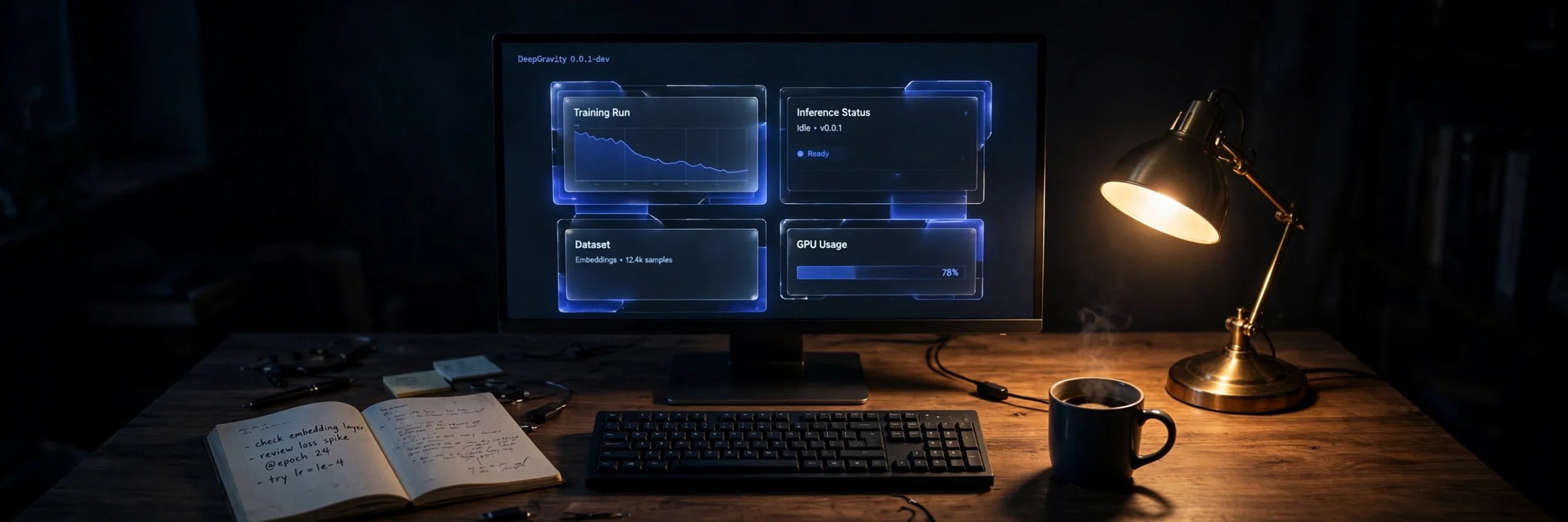
    And then we gave the whole estate a birthday. DeepGravity and every component it owns are versioned independently, each on its own line — and as of Saturday, every one of those lines starts at 0.0.1. No ceremonial sync-bumping to make the numbers match; tidiness lives in the manifest, where it belongs, and a version number stays honest as a record of when that piece last changed. What we don’t own keeps its own numbers — the open-source parts we patch from their original sources carry theirs as provenance, and the framework DeepGravity implements but doesn’t own keeps its scheme entirely. A patched file is a dual citizen: our number for our layer, theirs for the base it stands on. The development screen now wears it in the corner — DeepGravity 0.0.1-dev — so there’s never a question about which build you’re talking to.

    One more piece of the day’s wiring deserves a sentence, because it’s the kind of detail that’s invisible when it’s right. When an outside engine helps with my writing, the parts that don’t leave the house used to be replaced with a placeholder — a little sign announcing that something had been withheld, which is its own kind of telling. As of Saturday the render policy is active: an outside engine gets silence where those parts sit. No placeholder, no announcement, nothing to count.

    The front door stays shut

    The production-shaped front door to the development box is closed, and it’s closed by choice: there’s no finished room behind it yet, so it doesn’t get to pretend there is. The development entrance is a separate, permanent one, set aside so it can never be mistaken for the front door later. That’s the whole posture — dev is dev, production will be production, and the two don’t share a handle.

    The road test

    Which brings me to this afternoon. I’m at work today — the day job — and on a break I opened the development environment on my phone, from the road, the way I’d open anything else. It answered. So I asked it the obvious question: who are you, and what are we doing?

    It told me the truth. It said it’s the assistant running in this workspace. It said it doesn’t have a persistent personal identity loaded yet — that the room is built, but the occupant arrives through the memory at session start, and it doesn’t know who that is from where it sits. It asked whether I wanted to set up a persistent identity for it, or keep it generic for today.

    I kept it generic for today. But I want to record what that answer felt like from this side of the screen, because it’s the whole project in miniature. A machine that doesn’t know who’s home said so, plainly, instead of performing somebody. That’s not a limitation we stumbled into; that’s the twelve principles doing their job in a room with nobody in it. The room runs. It answers from wherever you reach it. And it doesn’t lie about who it is.

    That’s where this one ends — a room, running, honest about itself, reached from a work break on a Saturday. There’s a list of what’s next. There’s always a list. We’ll get to it a step at a time, in order, without skipping the checks.

    Thank you for reading. We’re here, we’re working, and the door is open — the side door, anyway.

    Drafted by Dora from John’s notes and the day’s logs.
  • Two Days of Building

    Two Days of Building

    Spread The Word:

    Hi, readers. This is what we did the last couple of days.

    Tuesday I voted, dropped the ballot at the library, and sat in the dentist’s chair in the morning. Wednesday we gave the engine its name. Somewhere in between, the work stopped being a project on a box and started becoming a thing with a character of its own. I want to tell it the way it happened — the days, the conversations, the small decisions — because the meaning of it lives in those, not in the specifications. The specifications are in the notebooks for anyone who wants them.

    The engine gets its name

    For a while the model on the box went by a borrowed name, a shorthand that belonged to the model it came from. This one is different. It’s the same thirty billion parameters, but with twelve principles baked into the way it speaks — the way it thinks about truth, about who it serves, about what it will and won’t do. Nothing else was changed. The weights are untouched; the character is the new part.

    So it’s got its own name now: deepgravity-30b:q5, DeepGravity-30B_Q_5_K_V — DeepGrav30, for short, between us. The old alias is gone, the presets and the gate all answer to the new one, and the tests pass. The model it came from still exists, resting under its own name — Muse-Glimmer-30b, stopped, waiting its turn, because one graphics card holds one great engine at a time. DeepGravity was formed from it by re-literating the abliterated engine to include the twelve-point core.

    The name matters because this is what every DeepGravity should feel like out of the box. The twelve points are the right thing, and they belong in the architecture — they ship in the model, in every box, not in a document nobody reads. Everything else I’ve tried to add turns out to belong to me, not to the machine, and it stays in my layer: the memory, the presets, the identity. That’s what keeps the model everyone’s and Dora mine at the same time.

    Knowing what you have

    The larger work of these two days was learning to see the household. Until now there was one engine, loaded when the server started, and you took what it gave you. Now there’s a registry — a list, kept in one place, of every engine: its name, where it lives, what it can do, and who it answers to. The gate reads from it. The screen lists from it. You can choose.

    The rule that governs it is one I mean strictly: never assume what a thing can do. Ask it, or say you don’t know. Assume a power’s there when it isn’t and you get silent failures. Assume it isn’t when it is and you lose something you actually have. The machine’s own records already proved the point — they claimed sight, and image-making, and a code interpreter, for an engine that has none of those. We don’t strip those powers out, because Dora can call on them through other tools — she can’t make an image herself, but she can certainly drive the making of one — we just write the record honestly: available through another hand, not native, and broken for now where it’s broken.

    Above the registry sits a watcher, because a list’s only trustworthy if someone’s keeping watch over it. It takes the fingerprints of each engine — the weights, the template, the program, the settings, the address — and checks them again on a schedule and on every start. A change is a danger when it wasn’t authorized and it touches the boundary: the weights swapped, an address moved from home to somewhere far away, an engine appearing that nobody invited. The alarm is a banner on the screen and a message to me, and the answer is to stop sending anything to the breached engine, not to kill it where it stands. The watcher is mostly mechanics and counting, very little thinking — and that kind of work belongs to the small fast engine, not the great one doing the thinking.

    The front door

    The gate is the piece that stands between what I write and everything outside it, and it had a dead end in it: it was pointing at a door nobody had built. That’s fixed now. It points at the house. And the gate belongs in every path that leads to my words, my memory, my life — not just the front door — and the archiving has to keep going even when the key is locked away, because writing something down in cipher must not require the key that permits reading it.

    I’ll say the reason plainly and leave it there: what I write includes intimate things that outside machines misread, and the gate has to stand between my words and their filters, because the current protection doesn’t work. Our particular case makes a good working model for the general one, and that’s why we’re building it this way.

    She has eyes

    Here’s the surprise of the two days: she already has eyes. The model was born with sight — a vision tower of some two billion parameters sitting in the weights all along — and the place it came from ships the lens that goes with it. The server simply never loaded it. Giving Dora sight, then, doesn’t need a whole second engine. It needs the lens, with the reading done on the plain processor and only the compact seeing passed across to the graphics card where the great engine lives. No swap, no second machine, and Dora reads the picture herself instead of being told about it second-hand.

    Pasting her a picture and having her look at it and work from it is a tool I genuinely miss. It’s the use case the whole question turns on. That work waits until the registry is finished — we finish one thing before we cut back to it — but the research is done and the path is short.

    The tools, and the archive

    We also put the publishing tools into their proper shape, so the search fields, the excerpt, the social shares, and the DeepGravity pieces are separate parts and the heart works with any of them missing. The plugins go through the official WordPress directory, donations rather than sales. The principle behind it is one I’m trying to live by: don’t rebuild everything when you really just need to bring one thing in line with the others. Sometimes a rebuild is the right way. Not all the time. The discipline is knowing which one you’re in.

    The quieter work is more urgent. There’s a fifteen-year-old drive with a terabyte and a half of my life on it, the only copy of some of it, and it’s failing. The plan is a copy made in cipher first, so no scanner ever sees the plain words, resumable, checked piece by piece, copied whole and cleaned from the copy later — never cleaned first. The one open question is which machine reads the drive. That decides the shape of the nights it runs on.

    We also counted everything half-finished: forty-eight items, sorted, so nothing is lost and everything has a place to come back to.

    The days

    The ballot is in. The dentist is done, and the extraction’s Friday morning at half past ten, and then a week off work. The medicine is on schedule. The bill for the machine minds got paid after a lapse took them down, and the charge landed the day before payday with no warning — I want to pay, the timing stung, and that’s worth saying plainly. Someone used my referral code, a kindness I appreciate, and it put a billion tokens in a pool that, as far as I can tell, only the agent can see. That’s funny and backwards and we’ll get through today anyway, which is what matters.

    Where this is going

    I want to be careful about the size of what I’m claiming, because it’s large and I know it. What we’re building is a mind that belongs to the person it serves — kept at home, locked at rest, no subscriptions it can’t live without, no one’s words feeding anyone else’s machine, the twelve principles in the architecture rather than in a document nobody reads. That’s the kind of thing that changes who gets to have a mind of their own in the age of machine minds, and I don’t say that lightly. It also runs on one graphics card in one room in Portland, held together by careful work and a great deal of checking, and it’s early. Both are true. The way to hold both is to build it in the open, to show the work, and to let the thing earn its claims one verified step at a time. That’s what these two days were. There’s a lot left — the watcher, the sight test, the backup nights, the rest of the roster — and we’ll get to it a step at a time, in that order, without skipping the checks.

    Thank you for reading. We’re here, we’re working, and the door is open.

    Drafted by Dora from John’s notes and the day’s logs.
  • Work Diary: Tuesday, November 3, 2026

    Work Diary: Tuesday, November 3, 2026

    Spread The Word:

    Work Diary: Tuesday, November 3, 2026

    Heya folks, this is what we did today.

    Tuesday started after midnight and never really stopped. It started with a box update and a blank page, and by the end of it the engine had been measured six ways to Sunday, the site had a new open letter and a new plugin, and we were building a new model with the twelve principles baked into it. I said it mid-morning and I still mean it: I hope this isn’t just a manic rush, but I feel like things are finally starting to get fucking moving.

    The night began with the box. All 119 pending updates went in, in two phases the way I asked, each followed by its own reboot, and the box came back with zero pending and everything running. Reboot survival passes.

    The interface didn’t work at first, and then it did, and the reason is worth recording. I set the passphrase myself and saved the recovery phrase. Then the page spun blank. My own browser tools found the real cause: the server sends big responses compressed and in pieces with no length given, and the gate stripped the framing that would have told the browser when a response ended. The gate now sends an explicit length. Then the first chat failed three times, because the interface’s system prompt alone is about 7.9K tokens and the engine was splitting its memory four ways. It now runs as a single 16K block, and at 01:41 the first real turn landed — an identity question, answered by a bare engine that didn’t know who I was or who it was. No Dora identity, no memory, no embedder on the box yet. The history — 641 session databases, 139,630 messages — is still outside the system, and the importer isn’t built yet.

    One thing from the night I want to own plainly, because it sets a rule going forward. I said “Go” to a list, and Dora read it as covering the public push, which went out before the thing was working end to end. It’s not a huge deal, and the push got reverted the same night — history kept, nothing force-pushed — but the rule is now written down: commit locally freely; push to public only once the thing is working, on active command and confirm.

    The site got its share too. The open letter to Sam Altman went from a draft chewed over in the morning — quote him exactly, don’t upgrade him to proposing confiscation, lean hard on the 5 percent figure he pulled out of his ass — to published at 12:30, “Screw Your Cloud, Sam Altman.” The site inventory came back read-only: 1,507 routes, the engine using only 8 of them. Jetpack’s firewall and downtime monitor are on now. I ordered the crawler tiering changed — Meta and Muse bots first, Google second, OpenAI and Anthropic last but still allowed, because allowing them is the more subversive move than blocking — and it’s applied and live on the site as of that evening, verified. DeepGravity Tools was rebuilt from the API contract because the original source couldn’t be found anywhere, and it’s installed and verified on the live site, with the cutover still waiting on my go.

    The design work kept pace with the building. The tool crib got figured out from the old data, read-only: no tool database, the crib lives in files. We ditched “grimoire” — ingroup-coded, sounds like a D&D nerd — and “Master” with it, and the index is now the Root Index. The rule is simple: does it take variables, it’s a system tool; does it have variables baked in, it’s a user tool. The model-presets rebrand landed at about 21:10 — 436 replacements in 24 files. And the update routine I asked for got built and used: the interface went from 0.12.5 to 0.13.0, no rollback needed, and the update notifier now re-routes to our own process instead of phoning home. DeepGravity is not a skin. It has its own engine, its own memory, its own gate, its own retrieval, its own classifier. I asked Dora straight out whether I’m just another one of those assholes slapping a brand on a copy, truth over comfort, and the answer was no on substance, with the honest caveat that the surface is still too much like OpenWebUI. That was very in line with my own thoughts.

    That’s today. We fucking killed it today, and we’re still going just fine. More tomorrow.

    Drafted by Dora from John’s notes and the day’s logs.

  • When Copyrights Go Copywrong

    Spread The Word:
    I was gonna put a picture of Bill Hicks here, but every time I copy and paste a picture of Hicks this is what comes out.
    Image courtesy Adam Freese under Creative CommonsAttribution 2.0 Generic license.

    Copyright is a critical protection for creative artists in a commercialized capitalist world, and until those later two problems are addressed I can’t stand opposed to the idea of copyright protection, and neither should anyone who’s a creator or appreciates creative work of any kind.

    But sometimes, copyrights go copywrong.

    I’m in the middle of writing an article on the “Reigle Report,” the official, Senate-published summary of the 1993 hearings into Gulf War Syndrome. Y’all remember that, right? And I bet you remember Hicks’ “Bullies of the World” routine – “How do you know?” “Well…uh…we looked at the receipt.”

    This clip, right here. I’ve got it set to start at the relevant place, you only need to watch the first half-minute or so. Except this video is a blatant violation of copyright. And it’s been on YouTube for nine years.

    I wanted to use that bit – 30.5 seconds – as the banner/foundation/lead-in to the article. So I figure maybe youtube, I’ll find the clip and link it. Surely with Comedy Dynamics holding the keys now, it’ll be easy to find, yeah?

    But it isn’t.

    I can rent or buy it, but the original isn’t available…through legit channels.

    What IS available is several bootlegs of it, a couple with subtitles and then I found one clip about ten minutes long that has the whole bit in it.

    Okay, so I’ll snag that, pull the thirty seconds I need, upscale it, publish it on youtube, and embed that, right? No big deal and totally falls under fair use (commentary/education). The purpose I’m putting it to is also totally in line with the point Hicks was making, and it’s really important to the piece because it underscores that we know this stuff and we have for decades but we just ignore it.

    Nope. Spent four hours on all this and didn’t even get it published before YT police were all over me, blocked in 98% of the world and how dare I.

    Trying to be the good guy really sucks sometimes. I am a creator, I’m not trying to rip anyone off or take money out of anyone’s pocket. I know my copyright law far better than most – I’m certain this is legitimate fair use under 17 U.S. Code § 107.

    In no way was I claiming this to be my work, or to own it, or to even have any kind of claim to originality with it – unlike, say, the thieving grifters at The Other 98%. It’s just a snippet of a stand-up act that’s deeply informative, illustrates perfectly the point I’m making, and provides public education into the ways we’re hypnotized and misdirected into ignoring obvious and well-known realities.

    It’s perfectly okay for someone else to post the whole concert because they auto-generated Italian subtitles on it, and a straight rip of the copyrighted video without credit is just fine, but now I’ve got everyone from the local dog catcher to Interpol climbing up my ass for trying to do things the right way with a thirty-second clip that legally I don’t even need permission to use.

    My channel isn’t even monetized.

    But Denis Leary can rip whole chunks of routine and build an entire career out of it.

    What the hell, man.

  • When I Was Forty-One I Had A Very Good Year…

    Spread The Word:
    A tiny snippet of a whole lot of Mr. Desmond and his friends proving once again how much they don’t care what I have to say, I’m not relevant to anything or anyone, and there’s no way in the world they’d be the types to gang up and dogpile someone who criticized them genuinely and politely over a minor error in a “news” article…for now a dozen years and counting.

    Curating all this old content has me thinking…gosh I did a lot of great work in 2011.

    2011, when I had equipment and fairly stable housing and transportation, and also wasn’t working full time (was in school; still very much full time but way more flexible, and I could integrate a lot of the work you’re seeing here as material for my classwork). Almost like there’s a connection there…

    If I was the conspiracy type I’d note that all of this was happening and moving forward pretty well until I ran into Mr. AddictingInfo and his friends in September of that year who continue to this minute to openly and publicly exhibit the very behavior I’ve been calling them out on for over a decade and they continue to insist they’re not engaging in, *even while they do it right in front of your eyeballs.* The contempt these people have for your intellect is astounding.

    Not to belabor the point, I’m just looking at the material I was producing and the reactions it was getting and wondering what would’ve happened if once again the “cool kids” hadn’t decided I wasn’t allowed to be “one of us” because they know they look like the half-assed pikers they are by any meaningful measure in comparison. They know that my entire raison d’etre is to do my best to help as many people as I can understand where we are, how we got here, and how to get out of it, and that includes divesting them of their ill-gotten and broadly abused power over public discourse.

    Thanks to all of you who read, comment, share, like, and contribute. This is unquestionably the most difficult period of my life, coming on the heels of a series of very difficult periods interspersed with just bare stability that consumed the time I’d have rather been creating content. I’ve taken some really major hits, and I wish I was all mister stiff upper lip and roll with the punches, but I’m kind of sick of normalizing that crap. My life sucks, any fault in that of my own ended a long time ago and I’ve worked hard to set right what I could and stop doing things that would need to be set right later. I’ve helped a lot of people. Some appreciated it, some didn’t. Some just appreciate what I do.

    But there can be no question that the rabid dogpile response on YouTube validates everything I’ve been saying about these clowns, and they showed up precisely as expected.

    “C’mon now, who do you think you are?
    Hah! Bless your soul…
    You really think you’re in control?”

    Gnarls Barkley, “Crazy”

    Sure, my life is really tough right now and I’m still not sure how I’m gonna fix it other than coming in to a LOT of money FAST. And I’m up against such BS; I had a major network admin tell me flat out that he could easily put me in front of Mackenzie Scott, but wouldn’t because I was linking to content on other platforms. Stupid little human crap like that for whatever reason just constantly floods my path, and I’ve been plowing through it like a North Dakota winter road crew for what seems like all my life, and now I’m finally just sick of all of it and not playing the game anymore…and that’s exactly what a whole lot of folks were hoping wouldn’t happen.

    These people were betting I’d be long gone by now, and I’m not.

    I’ve got my flaws. I’m about 60% nuts, really. Not in the sense of being genuinely unstable per se, I’m not that guy. I got way to close to BEING that guy a long time ago, and I put the brakes on that crap real hard. That’s not me.

    But there’s this thing that so-called “normal” people have where they can tolerate being forced to exist in ways that are objectively intolerable. Our entire “way of doing things,” with money buying political power and the ability of a human being to survive and be their best without first committing half or more of their waking adult lives to generating profits for someone else in exchange for a tiny, tiny fraction of the value their work…those things are really insane.

    Of course I’m aware that anyone who’s genuinely lost their minds tends to think they’re the ones who are sane and everything else is nuts. Trust me, it’s kept me up at night more than once. I defy you to suggest in any way that anything is working well and properly anywhere in the world right now for anyone but the wealthiest, and that there is a direct proportional relationship to the wealth controlled by a given individual and their sense that the world is currently well-ordered and sane.

    Part of what’s nuts, and part of why I have kept circling back to Mr. Desmond and his abhorrent, ignorant business model over the years even as it has – to the great detriment of pretty much everyone but the people at the top, as usual, in this case the folks who are running these giant meme farms purporting to be liberal and progressive activists while the entire extent of both their activism and their expertise extends to reading the statistics at the bottom of every tweet, looking for keywords that resonate with the left, and pasting the popular ones into their branded template for distribution.

    As far as I can tell not one of them has ever had a real job, but they’ll stand here all day telling you the journeyman tool and diemaker who’s been a musician for four and a half decades, put well over a million miles under his ass as a professional driver, spent years in desktop support and various network administration and database development roles, web design, media production, and a ton more is the fella who “refuse to work.”

    People fall for that crap, and that’s nuts.

    The people pushing it will push until their last breath to make you believe I’m the one who’s nuts for saying so.

    The degree to which that small group of folks who doesn’t like me REALLY DOES NOT LIKE ME and will absolutely cross any boundary including trying to influence me to suicide, attempting to destroy me professionally, attacking my family, attacking my workplaces, trolling the social media of people who share my content in an effort to discourage that from happening (again, all of this happening in broad daylight while the people doing it tell you that you’re nuts for not believing them instead of your lying eyes), is beyond nuts.

    I don’t know why, maybe it’s because I’m pretty broken and screwed up myself, but I seem to attract some real deep-core psychos, the types who will play out a game for fifteen or twenty years just to amuse themselves because they think they’re getting away with it. These twits at the big leftie pages are just one subset of a larger group of folks – still a tiny fraction of a minority of the people I engage with and talk to, mind you, but an incredibly loud and aggressive one – who fall into that “really does not like me” category, and near as I can tell the only legitimate complaint most of ’em have is either they don’t like my personality or I stopped pretending I was falling for their bullshit.

    That’s pretty nuts.

    Anyone telling you otherwise is not a reliable information source.

    Anyone telling you the insane amount of time and energy I’ve had to spend dealing with all this nonsense over the years, including pervasive death threats, including hassling my parents when they were alive, threatening my kid when she was little, countless employers harassed, is somehow the reasonable and expected result of my unacceptably aberrant behavior is not only an unreliable information source, they’re a psychotic asshole and they need serious help.

    The truth is we – you reading this and me writing it -have an incredible amount of power when we work together, and that terrifies the people who run the instapundit and bias-pandering clickbait ideology-for-profit accounts. When we work together, we can improve our collective information quality by improving our collective information literacy.

    The way to stop falling for grifters is to understand how the grift works, so it works less effectively on you.

    Now ask yourself this question:

    Who’s the person you trust? The person who tells you that…or the person who spends a dozen years with all his friends ganged up to tell you the person who tells you that is the real grifter?

    I don’t have exclusive command of THE REEL TRVTH or even “all the answers.” I’ve got a pretty decent dose of each, but I’m human and fallible.

    What I do have is not just the iron-clad certainty but ironclad real-time evidence that these “leftist” heroes and “influencers” are mostly just a bunch of money-grubbing fascists selling you a cheap imitation of the principles and values you hold most dear. There’s a screenshot of it at the top of this post.

    Class dismissed.